Lower Blepharoplasty vs. Double Eyelid Surgery (Asian Blepharoplasty): Clarifying the Confusing Terms
When international patients begin researching eye rejuvenation or shape enhancement online, they quickly find themselves trapped in a web of dense medical jargon. Terms like "blepharoplasty," "double eyelid surgery," and "lower eyelid lift" are frequently tossed around interchangeably. This leaves many people wondering if these procedures tackle the same anatomical concerns.
The confusion stems from a shared root name. While both treatments fall under the technical umbrella of periorbital (around-the-eye) plastic surgery, they serve entirely distinct demographics, target completely opposite structures of the eye frame, and follow entirely separate aesthetic methodologies.
The Fundamental Split: Structural Rejuvenation vs. Architectural Creation
To understand why these two procedures should never be confused, it helps to look at what each surgery actually builds or alters. One is an anti-aging procedure designed to restore a flat surface, while the other is an architectural procedure designed to create a new facial feature:
- Lower Blepharoplasty: This is strictly an anti-aging, restorative procedure performed on the tissue beneath the eye frame. Its core purpose is to smooth out structural contours by removing or shifting protruding eye bags and filling in dark, tired valleys. It is a solution for structural fatigue, not a tool for modifying the shape of the eye itself.
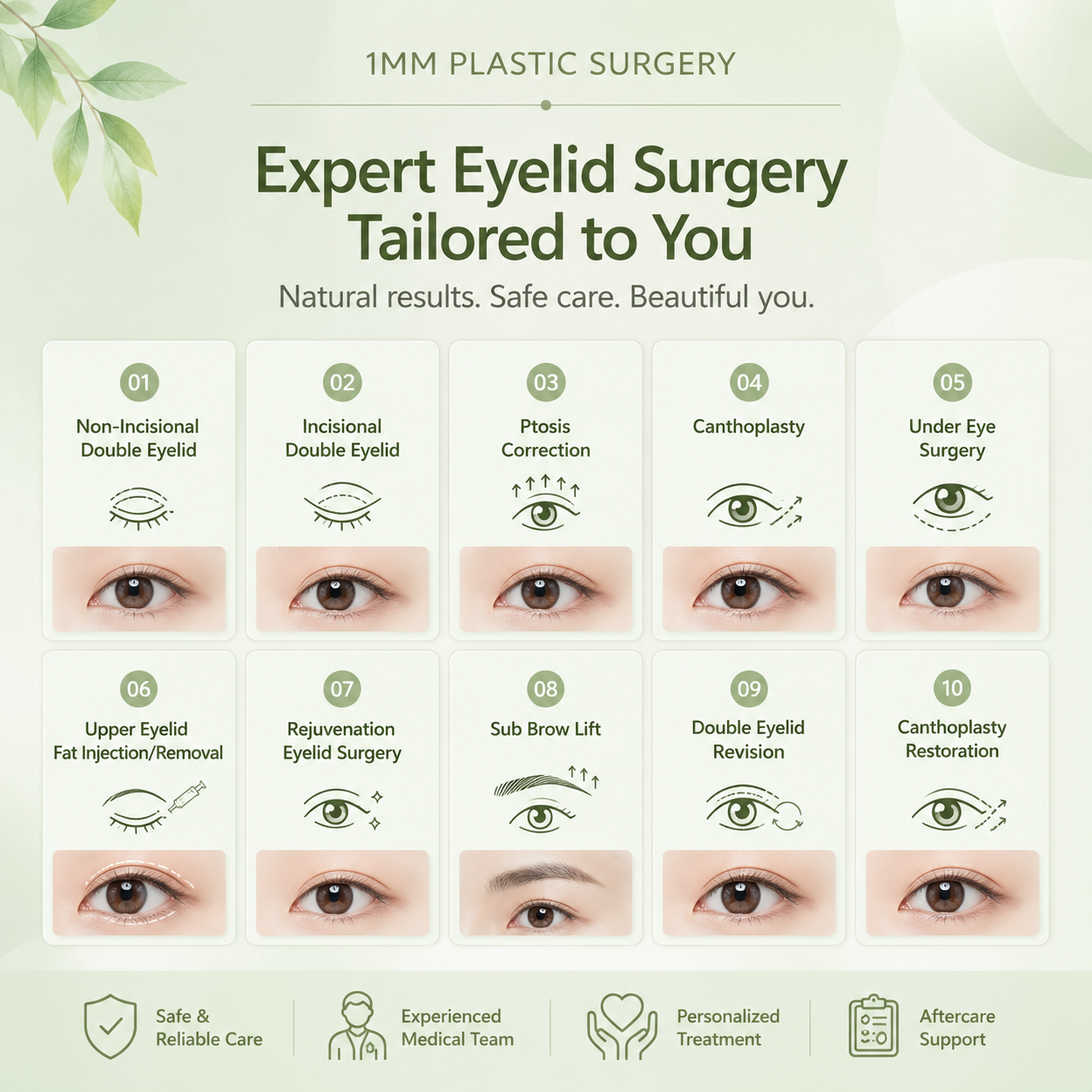
- Double Eyelid Surgery (Asian Blepharoplasty): This is a shape-enhancing, structural procedure performed exclusively on the upper eyelid. It is designed for individuals born without a natural upper fold (monolids). The surgical goal is to create a crisp, permanent crease where skin connects to the deep eye-opening muscle, transforming a flat lid into a dynamic double-eyelid frame.
Comparing Anatomy, Placement, and Surgical Approaches
The technical execution of these procedures differs across every step of the planning phase, from where the surgeon cuts to how the tissue behaves:
- Lower Blepharoplasty Placement: The surgical zone is entirely below the lower lash line. For most patients, it involves an internal, transconjunctival entry point hidden completely inside the lower eyelid. There are zero external cuts on the face, and the primary tissue handled is the deep orbital fat pockets that protrude with age.
- Asian Blepharoplasty Placement: The surgical zone is on the upper eyelid, a few millimeters above the upper eyelashes. It can be performed using a non-incisional (natural adhesion suture) method or a full incisional technique, depending on the thickness of the patient's skin. The primary tissues adjusted are the skin, the levator muscle, and the superficial fat pad above the eye.
The Financial Outline: Investment Guidelines in Seoul
South Korea’s specialized medical hubs offer clear, distinct pricing structures for upper creation versus lower restoration. The total investment reflects the technical approach selected during your structural consultation:
- Double Eyelid Surgery (Non-Incisional): The suture-based natural adhesion method for creating an upper crease ranges from $1,000 USD to $1,800 USD (approximately KRW 1,300,000 to 2,500,000).
- Double Eyelid Surgery (Full Incisional): When skin excision or complex muscle adjustment (ptosis correction) is needed to build the upper crease, the range shifts to $2,000 USD to $4,000 USD (approximately KRW 2,700,000 to 5,500,000).
- Lower Blepharoplasty: Under-eye fat repositioning to smooth out bags and tear troughs ranges from $1,800 USD to $3,500 USD (approximately KRW 2,400,000 to 4,800,000).
- Tax Refund Optimization: International patients visiting certified clinics in Seoul receive an instant tax refund of 7% to 10% at check-out, significantly reducing out-of-pocket costs.
Why Seoul is the Global Destination for Both Procedures
While the objectives of these surgeries are completely different, global patients travel to Seoul for both treatments due to the unparalleled expertise found within the city's medical districts:
- Mastery over the Asian Monolid: For double eyelid surgery, Korean surgeons have pioneered micro-suture techniques that create soft, natural adhesion folds. They avoid the overly deep, harsh, or artificial-looking creases often produced by Western surgical approaches.
- Pioneers of Internal Fat Repositioning: Instead of simply cutting away under-eye fat—which can leave the eyes looking hollow and aged—Seoul's specialists pioneered the technique of shifting that fat into lower hollows through invisible, internal incisions.
- Specialized Oculoplastic Experts: Medical facilities in Gangnam feature dedicated oculoplastic surgeons who focus exclusively on the periorbital zone, completing thousands of eye procedures annually to ensure maximum safety and precision.
The Post-Operative Healing and Recovery Paths
Because the upper and lower eyelids use entirely different tissue mechanics, your recovery experience will vary based on the procedure you choose:
- Recovering from Double Eyelid Surgery: If you undergo a non-incisional suture procedure, swelling drops drastically within 3 to 5 days, and there are no stitches to remove. For incisional double eyelid surgery, external threads must remain in place for 5 to 7 days. While initial swelling can make the new crease look unnaturally high or deep, it settles into its permanent, organic position within 1 to 3 months.
- Recovering from Lower Blepharoplasty: When performed internally, this procedure requires no external stitch removal, making the immediate surface healing much easier. However, because under-eye fat must be mobilized and anchored lower down, deep internal bruising and swelling peak around day 3 and take roughly 10 to 14 days to smooth out completely.
Final Thoughts
Distinguishing between lower blepharoplasty and Asian blepharoplasty is the first step toward planning a successful medical travel experience. If your goal is to eliminate tired under-eye bags and erase dark circles, a lower blepharoplasty is your correct path. If your goal is to change a flat monolid into an open, double-creased upper eye frame, you are looking for an Asian blepharoplasty.
By consulting with highly specialized surgical teams in South Korea, you can ensure that your specific structural needs are precisely met. This focused care delivers a natural, beautifully balanced result that complements your unique facial anatomy.